
How Uphead partnered with MedikaCloud to define its business strategy, architect its technology platform, build a full product roadmap, and design an AI-powered ERP that transforms how hospitals manage their supply chains.
Hospitals run on supplies. Surgical gloves, IV bags, medications, diagnostic consumables — the moment a critical item runs out, patient care is at risk. Yet most hospitals in emerging markets still manage their procurement with spreadsheets, gut instinct, and reactive emergency orders that cost significantly more than planned purchasing.
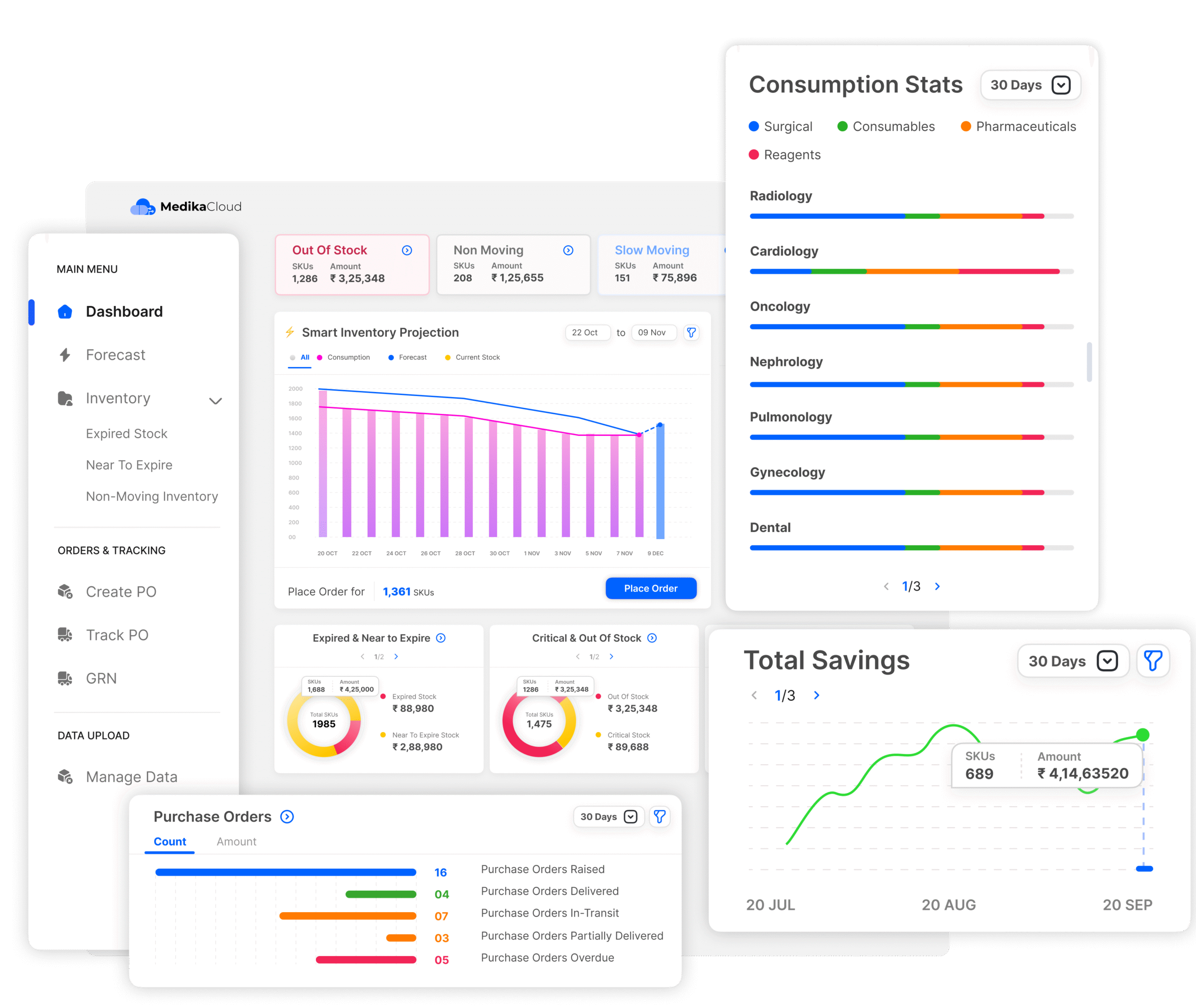
MedikaCloud set out to change that — building an AI-powered ERP specifically designed for healthcare supply chains. Uphead was brought in as a full-scope partner: from defining the business model and technology strategy, to designing the product and overseeing its implementation end-to-end.
Healthcare supply chain is not like retail or logistics. The stakes are categorically different. A stockout of surgical sutures or a critical medication is not an inconvenience — it is a clinical failure with real consequences for patients and staff.
And yet the tools most hospitals use to manage procurement have not evolved in decades. The problem MedikaCloud was solving was as much about institutional behaviour as it was about technology — which made both the product and the business strategy uniquely complex to get right.
"Build a platform that makes every hospital procurement team as precise, proactive, and data-driven as the best supply chain operations in the world."
Define how MedikaCloud creates value for hospitals, how it captures that value commercially, and how it enters and expands across healthcare markets in India and beyond.
Design a cloud ERP architecture that is scalable, secure, and capable of integrating with existing hospital systems — without the implementation complexity that kills enterprise software adoption.
Make AI-powered demand forecasting the platform's defining capability — giving hospitals the ability to predict supply needs before they become emergencies, not after.
Design a product experience that works for procurement managers and warehouse staff — not just IT teams — with an interface clear enough to drive adoption from day one without extensive training.
Sequence the platform's build in phases that deliver immediate value to early adopters while laying the infrastructure for advanced features, analytics, and market expansion.
Design an ERP implementation methodology that gets hospitals live in under 5 minutes — removing the weeks-long onboarding process that makes enterprise software adoption fail in SME healthcare settings.
Building a healthcare ERP from the ground up is not a single project — it is five parallel workstreams that each need to be individually rigorous and collectively aligned. Our approach kept strategy, technology, product, and implementation in continuous conversation, so no decision in one track created problems in another.
What MedikaCloud — and the hospitals using it — gained from this work.
Supply chain failures in hospitals are not abstract business problems — they affect patient outcomes. Our work with MedikaCloud was built on that understanding. Every strategic decision, every architectural choice, every design screen was made with the knowledge that this platform would eventually sit between a hospital and the supplies it needs to care for patients. That context demands a higher standard — and it is the standard we held ourselves to throughout.